Our best sellers
Operational Forecast
Regional Ocean Circulation Model
Regional Ocean Circulation Model

Our operational forecasts are tailored to the needs of our clients/partners.
Usually, we implement an operational forecast of the weather, ocean currents or waves, or all 3 together, being executed once a day, producing 7-day forecasts, using the previous day's forecast as initial condition.
However, we may also implement an operational forecast with data assimilation. In this case, the initial condition for each operational cycle is a analysis, which considers the previous day's forecast and observed data (Satellite Sea Level Anomaly, Satellite Sea Surface Temperature and vertical profiles of temperature and Salinity observed by ARGO buoys.
By "operational" we mean that the simulations are performed daily, without human interference, precisely at the same time, having a quality control system, which can take decisions in case of failure in accessing one of the online data that is needed to produce and deliver the forecast.
Regional Ocean Circulation Model
Regional Ocean Circulation Model
Regional Ocean Circulation Model

Numerical simulations of ocean currents in regional domains.
By "regional," we mean a domain that ranges from a few hundred kilometers to a few tens of kilometers. This includes coastal domains (near shore domains), estuaries, rivers, coastal bays and small seas.
We use the model Regional Ocean Modelling System (ROMS)
ROMS is an open source model, which means it can be used free of charge, as long as the user observes the conditions established by the authors of the model, which can be seeing at https://myroms.org
Our implementations of ROMS in regional domains usually use open boundary conditions from global models: either HNCODA (https://hycom.org) or NEMO/GLORYS (https://marine.copernicus.eu/access-data/)
For surface forcing we use either the Climate Forecast System (CFS), the operational model from NCEP/NOAA, or ERA5, the fifth generation ECMWF reanalysis.
Wave Model
Regional Ocean Circulation Model
Environmental Studies
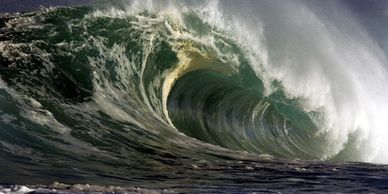
Numerical simulations of ocean waves (swell and sea) in regional domains.
For simulations of ocean waves we use the model Wave Watch III (WW3). It is an open source model which was initially developed in TUDELFT University but is now updated by the National Oceanic and Atmospheric Administration (NOAA).
WW3 is a third generation wave model developed at NOAA/NCEP in the spirit of the WAM model (WAMDIG 1988, Komen et al. 1994).
WW3 is a spectral model, which means that model solves the equation of advection of wave spectral energy, to propagate wave energy in the model domain. All processes, such as wind stress forcing at the surface, reflection, refraction, bottom stress, shoaling, are considered as source terms in the model.
Environmental Studies
AI applied to environmental data analysis
Environmental Studies

Comprehensive studies of coastal and oceanic environments including metocean data analysis and biogeochemical modelling.
Storm surge simulations
AI applied to environmental data analysis
AI applied to environmental data analysis

Short-term forecast of extreme weather conditions on the coast and their effects on coastal waves, river flooding, and their threats to coastal communities.
AI applied to environmental data analysis
AI applied to environmental data analysis
AI applied to environmental data analysis

Weather forecast based on neural networks:
by training a neural network to understand the patterns of weather, we are able to forecast future states of atmospheric conditions, including surface winds, sea surface temperature and atmospheric pressure.
Sea surface currents:
in this case we use a neural network that is trained on sea surface elevation and geostrophic currents, to forecast future states of ocean circulation.